In cloud computing, networking is fundamental to securely and efficiently connecting cloud resources and enabling communication between services and users.
Amazon Virtual Private Cloud (VPC) offers a logically isolated virtual network environment within the AWS cloud, where organizations can launch and manage their infrastructure similar to a traditional data center but with the scalability and flexibility of the cloud.
Understanding the core components and connectivity options of Amazon VPC is essential to architect secure and performant cloud applications.
Introduction to Amazon VPC
Amazon VPC provides a customizable and isolated virtual network that mimics an on-premises network in functionality but benefits from cloud agility.
Users can define their own IP address ranges using CIDR notation, subdivide networks into multiple subnets across Availability Zones for fault tolerance, and control routing, security, and connectivity.
This virtual isolation ensures that the resources within a VPC are shielded from other tenants and unauthorized access, supporting secure and compliant cloud operations.
Core Components of Amazon VPC
Below are the primary components that define how networks are segmented, secured, and connected within Amazon Web Services.
1. CIDR Blocks: The IP address range allocated to the VPC, for example, 10.0.0.0/16, defines the scope of IPs available.
2. Subnets: Logical segments within the VPC’s IP range allocated per Availability Zone. Subnets can be public (internet-accessible) or private (no direct internet access), enabling multi-tier application architectures.
3. Route Tables: Define how traffic flows within and outside the VPC, with rules directing network packets to gateways, subnets, or instances.
4. Internet Gateway (IGW): A horizontally scaled, redundant gateway allowing communication between the VPC and the internet for public subnets.
5. NAT Gateway: Allows instances in private subnets to access the internet for updates or outbound communication without exposing them directly.
6. Security Groups: Virtual firewalls managing inbound and outbound traffic for EC2 instances and other resources based on specified rules.
7. Network Access Control Lists (NACLs): Provide additional subnet-level security by filtering ingress and egress traffic with stateless rules.
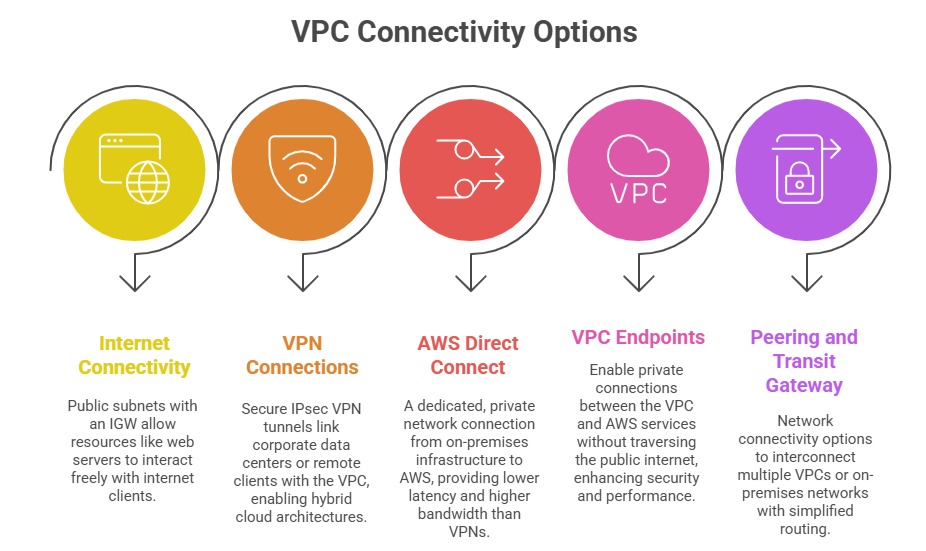
8. Virtual Private Gateway: Used for VPN connections linking an on-premises network to the VPC securely.
9. VPC Peering: Connects two VPCs, enabling routing of traffic between them as if part of the same network, useful for multi-account AWS environments.
Strategic Benefits of Amazon VPC Networking
These benefits enable businesses to design architectures that align with performance goals and compliance requirements.
1. Security and Isolation: Strict network boundary controls safeguard sensitive workloads.
2. High Availability: Multi-AZ subnet placement and redundant gateway architectures provide fault tolerance.
3. Flexible Network Design: Customizable IP ranges and routing support complex application topologies.
4. Cost Efficiency: Pay-as-you-go pricing and traffic routing optimization reduce costs.
5. Scalability: Easily extend or modify network configurations as application demands grow.