Before any model is built or data is analyzed, a data science project must begin with strong business understanding.
This step sets the direction, purpose, and boundaries of the entire project. Without it, even the most sophisticated models risk solving the wrong problem.
Business understanding focuses on knowing why a problem matters, what success looks like, and how the solution will create measurable impact.
Data science is not a purely technical field; it is an applied discipline that depends heavily on business context. Every industry finance, retail, healthcare, manufacturing, logistics, and even government has its own challenges, priorities, and constraints.
Understanding these nuances helps a data scientist design solutions that are realistic, valuable, and actionable.
For example, predicting customer churn means one thing in telecom, but something very different in SaaS or banking. Without deep context, the same model may generate the wrong insights or recommendations.
Another important part of business understanding is clarifying the underlying motivations behind the project.
Sometimes, stakeholders propose data science projects based on trends (“We need AI”), assumptions (“A model will fix this”), or pressure (“Other companies are doing it”). It becomes the data scientist’s responsibility to determine whether a data-driven solution is truly the right approach.
This prevents wasted resources and ensures alignment with real strategic needs.
Understanding the business also requires knowing who the stakeholders are.
These include business leaders, product managers, domain experts, engineers, analysts, and even end-users who will interact with the final solution. Each of these people holds a piece of the puzzle — goals, constraints, pain points, domain knowledge, or deployment requirements.
Importance of Business Understanding
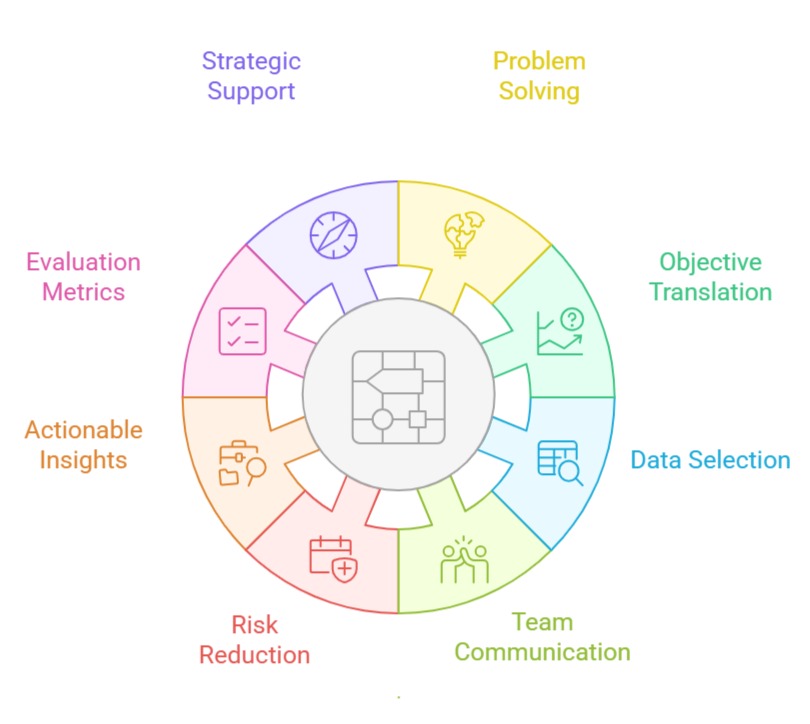
Business understanding is essential to ensure data science efforts focus on solving real, high-impact organizational problems rather than purely technical ones.
It aligns analytical work with business goals, enabling actionable insights, effective communication, and long-term strategic value.
1. Ensures the Project Solves the Right Problem
Business understanding helps data scientists identify what the organization truly needs rather than jumping directly into data and modeling.
Many projects fail because teams focus on interesting patterns instead of meaningful business challenges.
By clearly defining the real problem, the analysis becomes targeted and purposeful, increasing the chances of producing valuable outcomes.
This clarity prevents wasted time and resources. Ultimately, business understanding aligns technical work with actual organizational goals and user needs.
2. Helps Translate Business Objectives into Analytical Questions
Raw business goals such as “increase revenue” or “improve customer satisfaction” are too vague for direct analysis.
Business understanding bridges this gap by converting broad objectives into clear data science questions such as “which customer segments are most likely to churn?” or “which products generate the highest lifetime value?”
This translation guides the selection of methods, data sources, and metrics. It also ensures that the final insights directly support the business’s strategic priorities. Without this step, data science work can easily become disconnected from real goals.
3. Enables Better Selection of Relevant Data and Features
When data scientists understand the business context, they can identify which data truly matters and avoid collecting irrelevant or excessive information.
Business understanding reveals the factors that influence real-world outcomes—such as customer behavior, market trends, operational constraints, and domain-specific variables.
This helps in building stronger, more meaningful datasets and selecting features that have true business impact. As a result, models become more accurate, interpretable, and practical for decision-making.
4. Improves Communication Between Technical and Non-Technical Teams
Data science projects involve multiple stakeholders—managers, domain experts, engineers, analysts, and decision-makers.
Business understanding ensures data scientists speak the same language as the business side, reducing confusion and misalignment.
This enables smoother discussions about goals, expectations, assumptions, and limitations.
Better communication helps stakeholders trust the analytical process and the final results. When everyone shares a unified understanding, the project flows more efficiently and collaboratively.
5. Reduces Risks, Costs, and Project Failures
A lack of business understanding often results in incorrect assumptions, wrong problem framing, and wasted efforts on unnecessary models. This leads to project delays, higher costs, and solutions that do not deliver value.
By grounding every step in business context, teams minimize these risks and avoid investing resources in non-impactful tasks.
Business understanding ensures the team focuses on high-value areas and makes informed decisions.
This improves the overall success rate of data science initiatives and reduces financial and operational risks.
6. Ensures Insights Are Actionable and Useful
Data science becomes impactful only when insights are converted into actions that improve business outcomes.
Business understanding helps data scientists tailor insights in ways that stakeholders can implement—whether optimizing a process, improving customer targeting, or enhancing product design.
It ensures that the results are not only statistically correct but also practical, relevant, and aligned with business constraints.
This leads to real improvements and measurable benefits for the organization.
7. Guides Evaluation Metrics and Success Criteria
Different problems require different performance metrics—accuracy for classification, RMSE for forecasting, ROI for marketing decisions, etc.
Business understanding helps teams choose the right evaluation metrics based on what matters most to the organization.
It also defines what “success” looks like: a 10% reduction in churn, a 5% improvement in sales, or faster operations.
Having well-defined success criteria enables clear tracking of progress and ensures the final results deliver meaningful impact.
8. Supports Long-Term Strategy and Decision-Making
Business understanding connects data science efforts with the company’s long-term vision, ensuring the project does not just solve a short-term issue.
It helps identify broader opportunities, future risks, and areas where data-driven insights can support strategic growth.
This long-term perspective helps organizations stay competitive, adapt to market changes, and build sustainable systems.
With strong business understanding, data science becomes a strategic asset rather than just a technical function.