This stage focuses on clearly understanding the problem you want to solve and the value the analysis should deliver.
Well-defined objectives provide direction, while carefully framed questions guide data collection, analysis, and modeling.
Without clear goals, even high-quality data and advanced techniques can lead to irrelevant or misleading results.
Using the SMART Framework
Setting well-defined objectives is one of the most critical steps in a data science project.
Stakeholders often begin with broad aspirations such as “increase revenue,” “improve operations,” or “reduce churn,” but these goals are too vague for technical teams to translate into actionable tasks.
The SMART framework — Specific, Measurable, Achievable, Relevant, and Time-bound — provides a disciplined approach that transforms high-level ambitions into precise, actionable project goals.
The value of SMART lies in eliminating ambiguity. When objectives lack clarity, teams interpret them differently, leading to inconsistent expectations, unclear responsibilities, and eventual misalignment.
SMART objectives prevent this by explicitly defining what needs to be achieved, how success will be measured, who is involved, why it matters, and when it needs to be completed.
A SMART objective must also be measurable, which is essential in data science because modeling success depends heavily on quantification.
For example, instead of saying “improve customer satisfaction,” a SMART objective would specify metrics like “increase average satisfaction score from 3.8 to 4.2 within six months.” This clarity helps determine the required data and model evaluation metrics.
The “achievable” component forces teams to be realistic. Data science initiatives often fail because goals exceed the available data quality, computational resources, or business constraints.
The SMART framework encourages teams to reflect on feasibility before committing resources, saving time and preventing frustration.
Relevance is another key element. A data science project must align with broader business strategy.
Creating a highly accurate model is pointless if the outcome does not support core business priorities. For example, improving operational efficiency may be more valuable than optimizing marketing spend in a given quarter.
Finally, time-bound objectives ensure accountability. Without deadlines, projects drift, lose priority, or expand unnecessarily. Timelines help structure work into phases and enable periodic evaluation so teams can adjust course early if needed.
Transforming Business Goals into Data Science Objectives
Even after business leaders articulate their goals clearly, data teams must translate these goals into analytical objectives that define how data
science will contribute to achieving them.
This translation step is essential because business goals are expressed in strategic language, while data science operates in analytical terms such as prediction, classification, segmentation, or pattern detection.
Another important aspect of translation is understanding constraints and adjusting the analytical objective accordingly.
This translation process begins by identifying the decision or action that the business wants to improve. For instance, a business might want to “increase customer retention.
” To translate this into a data science objective, we must determine what underlying decision depends on data. In this case, understanding which customers are likely to churn becomes crucial.
The data science objective becomes: “Build a model that predicts customer churn probability within the next 30 days.”
This conversion is more than simply rephrasing — it clarifies the target variable, the prediction window, and the desired output. It grounds the project in measurable outcomes that data science techniques can tackle.
Sometimes the transformation involves designing analytical workflows instead of models. For example, if the business goal is to “improve operational efficiency in manufacturing,” the data objective might be “Analyze machine logs to identify common fault patterns and generate recommendations for preventive maintenance.
A business might want real-time fraud detection, but if they lack streaming infrastructure, the data objective may shift toward batch detection with periodic monitoring.
This ensures the data science solution remains realistic and implementable.
This transformation step also helps identify the data needed. If the business wants to improve customer lifetime value, the data science objective might require historical transactions, browsing history, support interaction records, and demographic information.
Defining the objective helps teams ask the right questions early and prevents data gaps from surfacing mid-project.
Finally, translating business goals into analytical objectives ensures the final model or insight is directly tied to business impact.
It makes it clear how technical work contributes to strategic value, fosters alignment among cross-functional teams, and supports measurable success.
Identifying Key Analytical Questions
Analytical questions shape the entire direction of a data science project. They convert objectives into specific questions that data analysis must answer.
These questions serve as the guiding compass for data exploration, modeling, feature engineering, and interpretation.
Well-formulated analytical questions are precise, structured, and directly linked to the business objective.
Analytical questions typically fall into several categories:
They ensure that analytical work remains focused instead of drifting into irrelevant explorations or overly broad investigations.
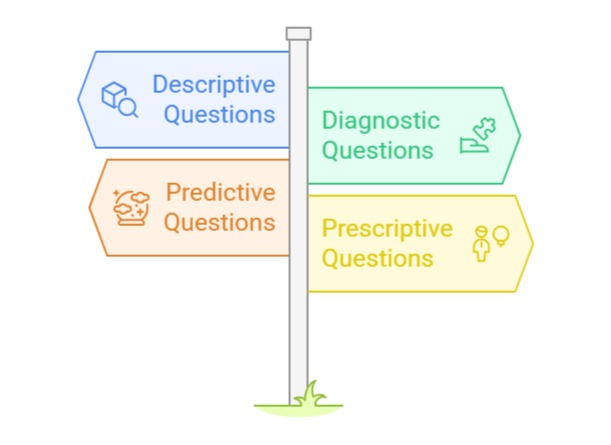
1. Descriptive Questions
These questions examine what has happened in the past. Examples include:
1. What customer groups exhibit the highest churn rates?
2. Which product categories produce the most returns?
These questions help teams understand patterns and prepare for the next steps.
2. Diagnostic Questions
These questions attempt to uncover why something is happening. They identify root causes, correlations, drivers, and influential factors. For example:
1. Why do high-value customers churn disproportionately?
2. What factors contribute most to delivery delays?
These insights guide feature engineering and strategy recommendations.
3. Predictive Questions
These questions estimate future events using historical data. Examples include:
1. Which customers are at risk of cancelling in the next 30 days?
2. What will the expected sales be for next week?
Predictive questions drive the creation of machine-learning models.
4. Prescriptive Questions
These questions focus on actionable recommendations based on predictions. Examples:
1. What offer is most effective for retaining each customer segment?
2. How should inventory be allocated to minimize shortages?
These questions connect analytics to strategic decisions.
A well-defined analytical question prevents misalignment between the data science team and stakeholders.
For example, if a business wants to understand why conversion is low but the data team attempts to build a predictive model, the mismatch wastes time and weakens trust. Clear analytical questions eliminate such issues.
These questions also help determine what data is needed. For example, a question about predicting customer churn requires data on customer behavior, demographics, interactions, and past churn patterns.
Knowing the question early guides which data sources to integrate and which features to engineer.
In short, analytical questions are the intellectual backbone of a data science project.
They translate objectives into technical clarity and ensure the entire workflow stays focused and efficient.
Evaluating Feasibility of Objectives
Before starting any project, it is crucial to evaluate whether the objectives are realistically achievable with the available resources, data, skills, and infrastructure.
Many data science projects fail not because of poor modeling, but because the initial objectives were unrealistic or unsupported by adequate data.
Feasibility evaluation begins with assessing data availability.
Teams must check whether the data needed to answer analytical questions exists, whether it is accessible, and whether its quality is sufficient.
Missing values, inconsistent formats, lack of historical depth, or small sample sizes can significantly limit what is possible.
For example, if a company has only three months of transaction data, attempting to forecast yearly sales trends may be unrealistic.
Next, teams must evaluate data quality. Even if data exists, it may contain errors, duplicates, bias, or noise. Poor-quality data can weaken model performance or lead to misleading insights. Feasibility checks help teams decide whether data cleaning or additional data collection is required before modeling.
Feasibility also depends on technical and human resources.
A company may want a deep-learning model for image recognition, but if they lack GPU infrastructure or staff trained in deep learning, the solution would be difficult to build and maintain.
Evaluating resource constraints helps teams select realistic modeling approaches and avoid overly complex solutions.
Another dimension of feasibility comes from ethical, regulatory, and privacy requirements. Some data cannot be utilized due to GDPR, HIPAA, or internal governance restrictions.
For example, personal identifiable information (PII) may require anonymization or may not be usable at all. Feasibility checks identify these limitations early so objectives can be modified without disrupting progress.
Time constraints are equally important. Businesses often expect quick results, but certain models require extended data collection, feature engineering, or validation.
If time is limited, teams may opt for simpler, more agile models rather than complex ones that require extensive experimentation.
Finally, feasibility evaluation examines business readiness. Even if a model performs well, the business must be able to operationalize it.
For example, deploying a real-time fraud detection model requires APIs, microservices, and monitoring systems. If such infrastructure is missing, teams may need to adjust the objective toward batch processing or reporting insights instead.
Feasibility evaluation ensures that the project is grounded in reality.
It protects teams from pursuing objectives that cannot be achieved and enables informed adjustments before significant resources are invested.

Class Sessions
Sales Campaign

We have a sales campaign on our promoted courses and products. You can purchase 1 products at a discounted price up to 15% discount.