A disciplined review of the workflow ensures learnings are captured, risks are mitigated, and future work is faster and safer.
Reviewing is not a one-time audit it’s an iterative, documented process that spans from project inception through production maintenance.
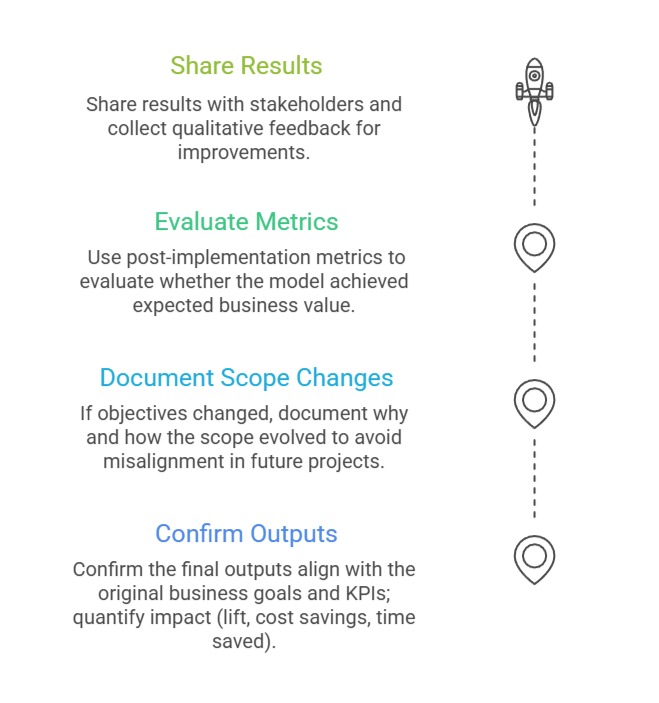
Revisit Business Objectives & Success Criteria
Data Audit & Provenance
1. Record data lineage: sources, transformations, cleaning steps, and versions so every prediction can be traced back to input data.
2. Verify that the data used in production matches the development/test datasets in schema and distribution.
3. Log data quality checks and any manual interventions performed during the project.
4. Store artifacts (samples, schema, validation reports) for reproducibility and audits.
Model Validation & Performance Review
1. Re-run evaluations on hold-out and production-like data, checking performance across subgroups and time slices to detect degradation.
2. Assess calibration, confusion matrices, precision/recall trade-offs, and application-level metrics to ensure the model behaves as intended.
3. Conduct adversarial checks and sensitivity analyses to probe robustness and failure modes.
4. Document limitations, caveats, and known biases clearly in model documentation.
Deployment Checklist & Operational Readiness
1. Verify deployment infra: APIs, latency, monitoring, rollback mechanisms, data pipelines, and dependency management.
2. Ensure there are alerts for model drift, data schema changes, degradation in input quality, and unusual traffic patterns.
3. Plan for operational tasks: scheduled retraining, resource scaling, and incident response procedures.
4. Provide runbooks for SREs and product teams that explain how to operate and revert the system.
Monitoring, Logging & MLOps
1. Implement continuous monitoring for data drift, concept drift, performance, and fairness metrics; automate alarms for deviations.
2. Log inputs, model versions, predictions, and feedback to support debugging and retraining.
3. Automate CI/CD for data and models where feasible to reduce manual errors and accelerate iteration.
4. Adopt MLOps practices (pipeline orchestration, containerization, model registries) to ensure reliability and reproducibility.
Documentation & Knowledge Transfer
1. Produce clear, accessible docs: README, model cards, data dictionaries, experiment logs, and code comments.
2. Hold handover sessions with stakeholders, product owners, and operations teams to transfer tacit knowledge.
3. Keep a “decision log” that records why specific modeling choices were made (features selected, metrics prioritized).
4. Use templates for reproducible reporting and postmortems to standardize lessons learned.
Ethical & Regulatory Review
1. Conduct a final ethical risk assessment and legal compliance check before continuing or expanding use.
2. Ensure that consent, retention policies, and audit trails meet regulatory requirements.
3. Prepare public-facing documentation or transparency reports where needed.
4. Allow external review if project carries public risk (third-party audit or bias assessment).