In the context of implementing an Information Security Management System (ISMS) according to ISO/IEC 27001, identifying interested parties and understanding their requirements is a fundamental step.
This process ensures that the ISMS addresses the needs, expectations, and concerns of all relevant stakeholders, making the system effective, aligned with business objectives, and compliant.
Who are the Interested Parties?
Interested parties are individuals or organizations that can influence, be influenced by, or perceive themselves to be affected by the organization's information security activities and outcomes.
These parties may be internal or external to the organization. Their interests can be diverse, some may have positive stakes (e.g., customers expecting robust data protection), while others may represent risks or challenges (e.g., competitors, hackers).
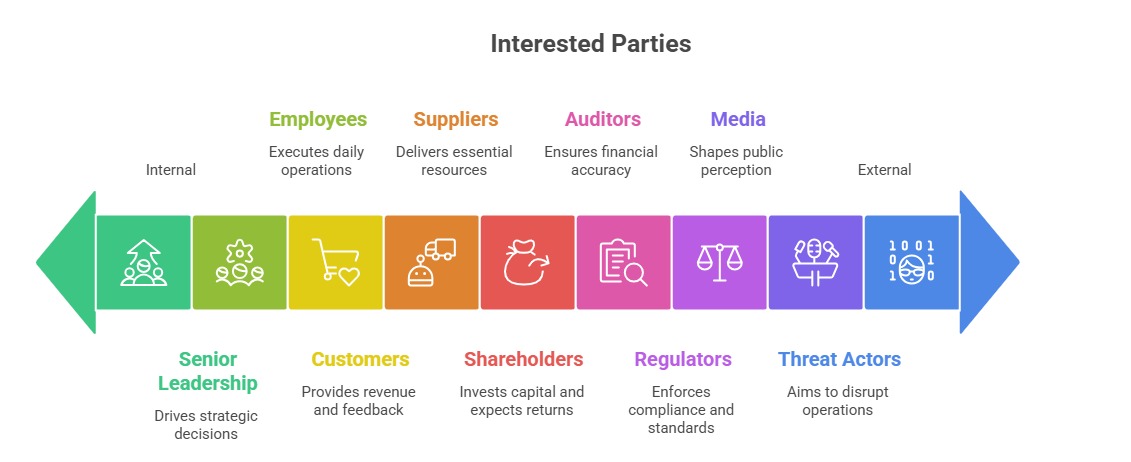
Why Identifying Interested Parties Matters
ISO/IEC 27001 Clause 4.2 requires organizations to determine who these interested parties are, understand what their needs and expectations entail, and decide which of those requirements the ISMS must address. This influences the ISMS’s design, risk assessments, controls, and communication strategies.
Failure to consider key stakeholders can cause several problems:
1. Misalignment between ISMS objectives and organizational priorities
2. Overlooking critical security risks
3. Lack of leadership support or employee buy-in
4. Non-compliance with legal or contractual obligations
5. Loss of customer trust
How to Identify Interested Parties
Organizations often use various methods, including:.png)
Understanding Requirements of Interested Parties
Once identified, organizations must understand each party's specific needs regarding information security. For example:
1. Customers may require assurance on data confidentiality and availability
2. Regulators expect compliance with privacy laws
3. Employees need secure and clear policies for handling sensitive data
4. Shareholders desire business continuity and risk mitigation
These requirements should be documented clearly and serve as inputs to risk assessments, control selection, and ISMS policies.
Meeting and Communicating Requirements
Demonstrating how the ISMS meets these needs is essential for both internal alignment and external audits. Organizations should establish mechanisms to communicate relevant ISMS information to interested parties, fostering transparency and trust.
Continuous Review
The needs and expectations of interested parties can evolve due to organizational changes, new regulations, technological shifts, or market trends. Regularly reviewing interested parties and updating the ISMS accordingly is vital to maintain its relevance and effectiveness.