Establishing robust information security policies is a foundational step in building an effective Information Security Management System (ISMS) aligned with ISO/IEC 27001 standards.
These policies serve as a formal declaration of the organization's commitment to protect its information assets and set the framework for how information security is managed across the enterprise.
What are Information Security Policies?
Information security policies are documented guidelines that define the organization’s approach to information security. They outline the principles, responsibilities, and management direction needed to safeguard data confidentiality, integrity, and availability.
These policies influence decision-making, set expectations for employee behavior, and provide a framework for implementing controls and procedures.
Importance of Establishing Security Policies
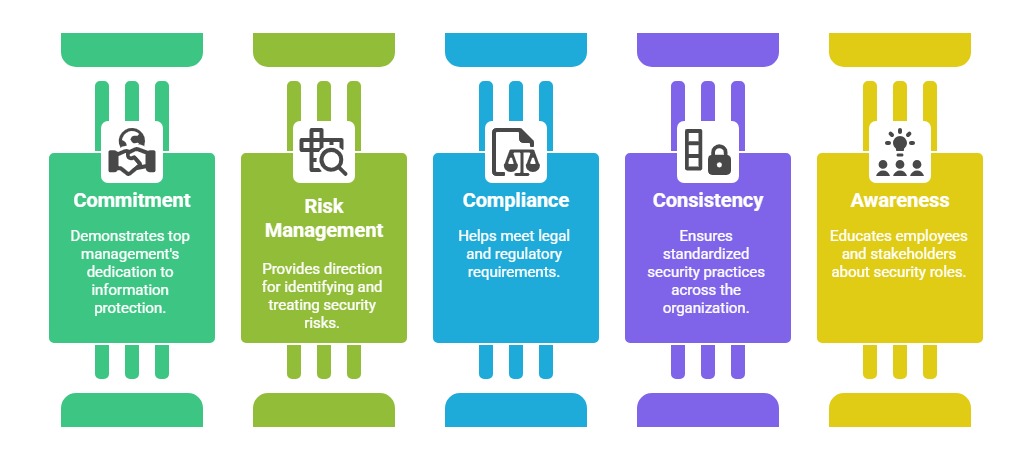
Security policies ensure that organizations implement consistent risk management and protect sensitive information effectively. Here are the reasons why developing such policies matters.
1. Demonstrate Commitment: A clearly articulated policy shows top management’s dedication to protecting information, which helps foster a culture of security awareness and accountability.
2. Guide Risk Management: Policies provide direction for identifying, assessing, and treating security risks effectively.
3. Support Compliance: They help organizations meet legal, regulatory, and contractual requirements related to data protection and information security.
4. Enable Consistency: Policies ensure that security practices are consistent and standardized across all business units.
5. Promote Awareness: Communicating policies educates employees and stakeholders about their roles and responsibilities regarding information security.
Key Elements of an Information Security Policy
ISO/IEC 27001 Clause 5.2 outlines the essential components that information security policies must include:
| Key Element | Description |
| Purpose and Scope | Defines the purpose of the information security policy, emphasizing its importance and specifying the scope—covering relevant assets, processes, and locations. |
| Information Security Objectives | States high-level objectives are aligned with business goals, focusing on maintaining the confidentiality, integrity, and availability of information. |
| Management Commitment | Demonstrates senior management’s support for complying with legal and regulatory requirements and their dedication to continual improvement of the ISMS. |
| Roles and Responsibilities | Clarifies responsibilities for implementing, maintaining, and monitoring information security, including top management, IT teams, and all employees. |
| Compliance Obligations | Includes a clear commitment to meet all applicable legal, regulatory, and contractual requirements related to information security. |
| Communication and Awareness | Describes how the policy will be communicated both internally and externally, and how awareness and training will ensure employee understanding and adherence. |
| Review and Maintenance | Specifies procedures for periodic review and updates to ensure the policy remains current and effective, at least annually or after significant organizational changes. |
Developing and Implementing the Policy
Developing an effective security policy involves collaboration among key stakeholders, including top management, IT, HR, and legal teams. Once drafted, the policy must be formally approved by senior leadership.
Communicating the policy through training sessions, intranets, or newsletters is essential so that all employees and relevant third parties understand and adhere to it.
Regular audits and management reviews ensure the policy remains up to date and continues to align with changing business needs, technology, and threat landscapes.
Supporting Policies and Policy Framework
The high-level information security policy typically acts as a master document supported by detailed subsidiary policies, such as:
1. Access Control Policy
2. Data Protection Policy
3. Incident Response Policy
4. Asset Management Policy
5. Risk Management Policy
Together, these policies create a comprehensive policy framework that supports effective ISMS implementation.