Defining the scope of an Information Security Management System (ISMS) is a crucial step in its successful implementation.
The ISMS scope clearly outlines the boundaries for both organizational and technological, within which the ISMS operates, specifying which assets, processes, systems, locations, and personnel are covered by the information security management activities.
This scoping provides clarity, focus, and ensures that information security efforts are appropriately directed.
Why is Defining the ISMS Scope Important?
The scope determines exactly what parts of the organization's operations and assets are protected and managed under the ISMS. A clearly defined scope:
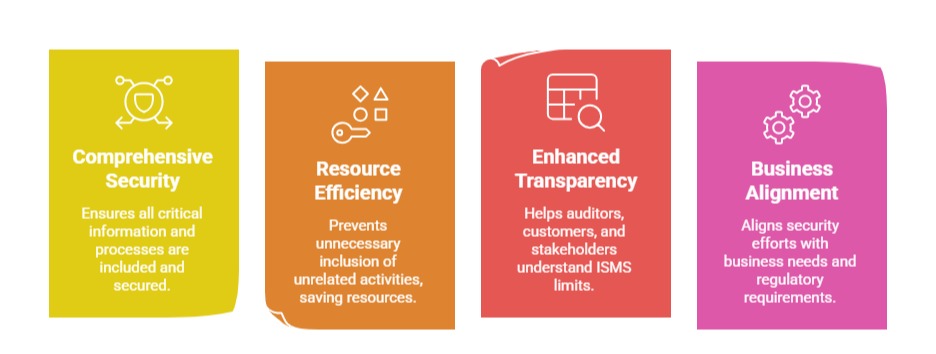
What to Consider When Defining the Scope
When scoping your ISMS, consider the following factors:
1. Organizational Units and Locations: Which departments, subsidiaries, or geographic locations will the ISMS cover? For example, a multinational corporation might limit its ISMS scope to certain business units or countries.
2. Information Assets and Processes: Identify the information to be protected, including digital data, paper records, intellectual property, and customer data, and the processes that create, store, transmit, or dispose of this information.
3. Technology and Infrastructure: Specify systems, networks, hardware, and software that support the covered processes.
4. External Interfaces and Dependencies: Consider third-party services, cloud providers, or partner organizations that interact with or affect the ISMS scope.
5. Legal, Regulatory, and Contractual Obligations: Scope should reflect compliance requirements that apply to the organization’s activities.
How to Define the ISMS Scope
Defining the scope is typically a collaborative effort involving leadership, information security professionals, and relevant stakeholders. Steps include:
| Step | Description |
| Review Organizational Context | Understand internal and external issues that influence information security, as required by ISO 27001 Clause 4.1. |
| Engage Interested Parties | Identify relevant stakeholders and determine their information security needs and expectations (Clause 4.2). |
| Map Processes and Assets | Document critical business processes and the associated information assets that support them. |
| Assess Risks and Dependencies | Identify potential threats, vulnerabilities, and dependencies, including interfaces with external parties or systems. |
| Document the Scope Statement | Develop a clear ISMS scope statement describing included organizational units, locations, systems, information assets, and any exclusions. |
For example, a scope statement might read: "The ISMS covers the design, development, deployment, and maintenance of the ABC SaaS platform, including associated customer data processing activities, within ABC’s primary data center and office facilities. Excluded are HR and finance departments, which are managed separately."
Maintaining and Reviewing the ISMS Scope
The ISMS scope is not static. As organizations evolve—through acquisitions, expansion, technological changes, or regulatory updates—their scope must be reviewed and adjusted to remain relevant and effective.
Continuous monitoring and periodic reviews are essential to ensure that the ISMS scope accurately reflects the current business environment and risk profile.