HTTP status codes, headers, and the request–response cycle define how clients and servers communicate on the web.
Status codes indicate the outcome of a request, headers carry metadata such as authentication, content type, and caching rules, and the request–response cycle describes the flow of a client request being processed by the server and returned with a response.
Understanding these elements is essential for building reliable, debuggable, and standards-compliant backend APIs.
HTTP Request/Response Cycle
The cycle starts with a client initiating an HTTP request specifying a method (GET, POST, PUT, DELETE, etc.), URL, headers, and optional body data.
The server receives this, routes it to the appropriate handler, processes logic like authentication, validation, and database operations, then crafts a response with a status code, headers, and body.
This stateless process repeats per request, enabling scalability but requiring careful state management via tokens or sessions.
Key Phases

HTTP Status Codes
Status codes are three-digit numbers grouped into five classes, signaling request outcomes to clients. Common 2xx success codes include 200 OK (request succeeded) and 201 Created (new resource made); 4xx client errors like 400 Bad Request (invalid input) or 404 Not Found; and 5xx server errors such as 500 Internal Server Error.
Use specific codes in APIs to guide client logic, e.g., return 204 No Content for successful DELETEs without body.
HTTP Headers
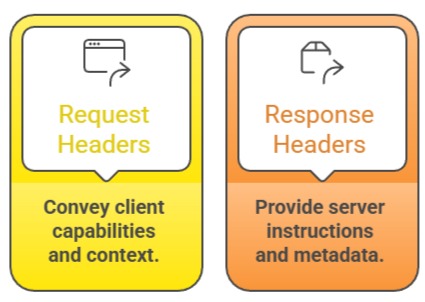
Headers are case-insensitive key-value pairs sent in both requests and responses, carrying metadata without touching the body.
Request headers include Accept (desired formats like application/json), Authorization (Bearer tokens), Content-Type (payload MIME), and custom ones like X-API-Key.
Response headers cover Content-Type (response format), Set-Cookie (sessions), Cache-Control (no-cache, max-age), ETag (versioning), and Location (for 201/3xx). Security headers like Strict-Transport-Security (HSTS) and CORS (Access-Control-Allow-Origin) are essential for APIs.
Headers enable features like compression (Accept-Encoding: gzip), pagination (X-Total-Count), and throttling (X-RateLimit-Remaining).
Common Pitfalls: Mismatched Content-Type causes 415 errors; missing CORS blocks frontend calls
Practical Implementation in Python APIs
In Flask/Django/FastAPI, return status codes explicitly: @app.post("/users") def create_user(): ... return {"id": 1}, 201, {"Location": "/users/1"}. Validate inputs early with Pydantic schemas to trigger 400/422; use try-except for 500s. Headers via response.headers["Cache-Control"] = "no-store".
Test Cycles Comprehensively
1. Use curl: curl -X POST -H "Content-Type: application/json" -d '{"name":"test"}' http://localhost:5000/users.
2. Postman collections for batch testing.
3. Monitor with tools like Prometheus for header-based metrics.
Debug by logging full requests: method, path, headers, body, status, response time. This expanded understanding equips you to design production-grade APIs.