Dependency Injection and middleware are key patterns used to manage cross-cutting concerns in backend applications.
Dependency Injection (DI) allows components such as database connections, services, or authentication handlers to be provided to endpoints in a clean and reusable way, improving modularity and testability.
Middleware runs before or after request processing, making it ideal for handling tasks like authentication, authorization, logging, and request validation.
Understanding Dependency Injection in Web APIs
Dependency injection is a design pattern where components receive their dependencies from external sources rather than creating them internally.
This inversion of control enhances testability, reusability, and flexibility—essential for full-stack APIs where security logic evolves rapidly.
In frameworks like FastAPI, DI is built-in via the Depends system, allowing you to inject authentication services into route handlers without tight coupling.
Why DI Matters for Authentication/Authorization
DI shines in security contexts by centralizing credential validation and permission checks. Instead of scattering if user.is_authenticated logic everywhere, you declare dependencies once and reuse them.

Consider a data science API serving ML model predictions: DI ensures only authorized analysts access endpoints, following Twelve-Factor App principles for configurable services.
Implementing DI for Authentication in FastAPI
FastAPI's DI leverages Pydantic models and OAuth2 standards. Here's a step-by-step process to set up JWT-based authentication:
1. Install dependencies: Use pip install python-jose[cryptography] passlib[bcrypt] python-multipart.
2. Define models: Create Pydantic schemas for User and Token.
3. Create verifier function: Build get_current_user using OAuth2PasswordBearer.
4. Inject in routes: Pass it as Depends(get_current_user).
from fastapi import Depends, HTTPException, status

from fastapi.security import OAuth2PasswordBearer

from jose import JWTError, jwt

from pydantic import BaseModel


oauth2_scheme = OAuth2PasswordBearer(tokenUrl="token")


class User(BaseModel):

    username: str

    email: str | None = None


async def get_current_user(token: str = Depends(oauth2_scheme)):

    try:

        payload = jwt.decode(token, SECRET_KEY, algorithms=[ALGORITHM])

        username: str = payload.get("sub")

        if username is None:

            raise HTTPException(status_code=401, detail="Invalid token")

        return User(username=username)

    except JWTError:

        raise HTTPException(status_code=401, detail="Invalid token")
This example verifies JWTs asynchronously, raising 401 errors for invalid tokens—aligned with RFC 7519 (JWT standard).
For Authorization, extend with role checks:
def require_role(role: str):

    def role_checker(current_user: User = Depends(get_current_user)):

        if current_user.role != role:

            raise HTTPException(status_code=403, detail="Insufficient permissions")

        return current_user

    return role_checker


@app.get("/admin/data")

async def admin_data(user: User = Depends(require_role("admin"))):

    return {"data": "Admin-only"}
Middleware: Intercepting Requests and Responses
Middleware acts as a filter chain, processing requests before they reach handlers and responses before they return to clients.
It's ideal for cross-cutting concerns like logging, CORS, and security headers, without cluttering route code.
In FastAPI, middleware is added via app.add_middleware, supporting ASGI standards for async web servers like Uvicorn.
Core Concepts and Use Cases
Middleware runs in a stack: incoming requests pass through each layer inbound, then outbound for responses. For auth, it enables token introspection or rate limiting early.
Key Benefits
1. Global enforcement: Apply auth to all routes uniformly.
2. Performance: Short-circuit invalid requests before heavy computation.
3. Observability: Log auth attempts for auditing.

Building Authentication Middleware
Follow these steps for a middleware that checks API keys:
1. Define the class: Inherit from BaseHTTPMiddleware.
2. Handle requests: Inspect headers in dispatch.
3. Short-circuit: Return 401 if invalid.
4. Add to app: app.add_middleware(AuthMiddleware, api_key="your_secret").
from fastapi import Request, HTTPException

from starlette.middleware.base import BaseHTTPMiddleware


class AuthMiddleware(BaseHTTPMiddleware):

    def __init__(self, app, api_key: str):

        super().__init__(app)

        self.api_key = api_key


    async def dispatch(self, request: Request, call_next):

        if request.headers.get("Authorization") != f"ApiKey {self.api_key}":

            raise HTTPException(status_code=401, detail="Invalid API key")

        response = await call_next(request)

        response.headers["X-Auth-Status"] = "verified"

        return response


app.add_middleware(AuthMiddleware, api_key="supersecret")
This adds a custom X-Auth-Status header for debugging, a best practice from OWASP API Security guidelines.
For authorization, chain middleware with DI: middleware handles coarse auth, DI fine-grained perms.
Combining DI and Middleware for Robust Security
The real power emerges when pairing DI (per-route flexibility) with middleware (global gates). This hybrid secures full-stack APIs end-to-end.
Practical Example: Protected ML Prediction API
Imagine a FastAPI service for data science predictions, requiring user auth and admin-only model updates.
app.py snippet
# Middleware for global API key check

app.add_middleware(AuthMiddleware, api_key="ml_service_key")


# DI for JWT user

@app.post("/predict")

async def predict(data: dict, user: User = Depends(get_current_user)):

    # Business logic: Use user.email for audit logs

    return {"prediction": model.predict(data)}


@app.post("/models", dependencies=[Depends(require_role("admin"))])

async def update_model(model_data: dict):

    # Admin-only

    pass
This Setup:
1. Blocks unauthenticated requests at middleware.
2. Injects user context for logging/personalization.
3. Scales to microservices with tools like Kong or Traefik for external middleware.
Best Practices and Common Pitfalls
Adopt these for 2025-era APIs:
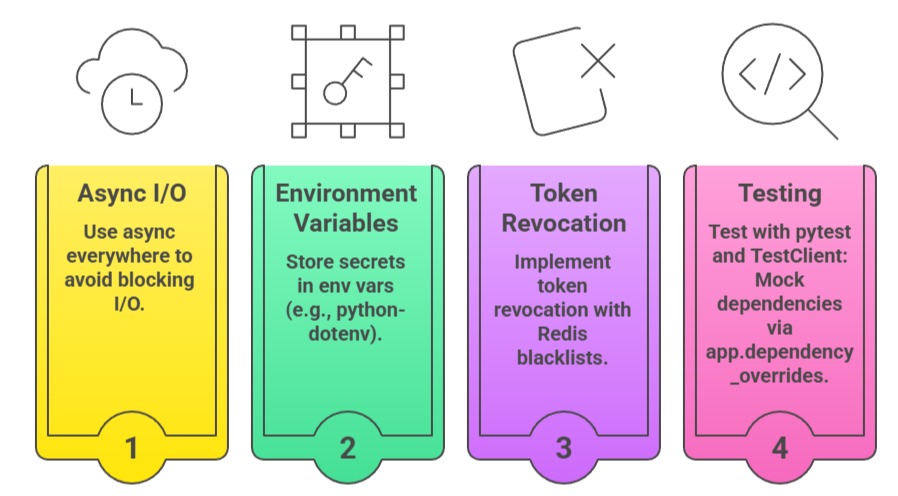
Avoid Pitfalls like:
1. Overusing middleware for everything—prefer DI for route-specific logic.
2. Ignoring CORS: Pair with CORSMiddleware for frontend integration.
In production, integrate with Auth0 or Keycloak for managed OAuth, reducing custom code.

Class Sessions
Sales Campaign

We have a sales campaign on our promoted courses and products. You can purchase 1 products at a discounted price up to 15% discount.