SQLAlchemy ORM with async support allows Python applications to interact with relational databases like PostgreSQL and MySQL in a non-blocking, asynchronous manner.
Introduced in SQLAlchemy 1.4 and refined in later versions, this approach is designed to work with Python’s asyncio ecosystem and modern async web frameworks.
By using asynchronous database drivers, developers can efficiently manage multiple concurrent database operations, making it well suited for scalable APIs, microservices, and high-performance backend systems.
Prerequisites and Installation
Start with Python 3.9+ and async database drivers to unlock SQLAlchemy's full async capabilities. This setup ensures compatibility with frameworks like FastAPI, central to our web API development course.
Install Core Packages using pip
1. sqlalchemy[asyncio] for ORM and async engine support
2. asyncpg for high-performance PostgreSQL connections
3. aiomysql for MySQL async operations
pip install sqlalchemy[asyncio] asyncpg aiomysql fastapiKey Benefit: asyncpg's C-based implementation delivers up to 3x faster queries than synchronous drivers, ideal for API endpoints under load.
Async Engine Setup
The async engine replaces traditional create_engine() with create_async_engine() from sqlalchemy.ext.asyncio. Connection strings use dialect prefixes like postgresql+asyncpg:// or mysql+aiomysql:// to enable non-blocking I/O.
Complete Configuration Example
from sqlalchemy.ext.asyncio import create_async_engine

from sqlalchemy.orm import DeclarativeBase


# PostgreSQL example

pg_engine = create_async_engine(

    "postgresql+asyncpg://user:password@localhost:5432/mydb",

    echo=True,  # Logs SQL for debugging

    future=True  # Enables SQLAlchemy 2.0 features

)


# MySQL example

mysql_engine = create_async_engine(

    "mysql+aiomysql://user:password@localhost:3306/mydb",

    pool_pre_ping=True  # Validates connections

)


class Base(DeclarativeBase):

    pass
Always call await engine.dispose() after use to release resources cleanly. Set pool_size=20 and max_overflow=10 for production to manage connection pools efficiently.
Async Session Management
Sessions handle ORM transactions asynchronously via async_sessionmaker. Use context managers (async with) to ensure proper rollback and closure, preventing leaks in concurrent API routes.
Create a session factory
from sqlalchemy.ext.asyncio import async_sessionmaker, AsyncAttrs

from sqlalchemy.orm import sessionmaker


async_session = async_sessionmaker(pg_engine, class_=AsyncSession, expire_on_commit=False)
Defining ORM Models
Models inherit from a Base class with AsyncAttrs for lazy-loading compatibility. Use SQLAlchemy 2.0's Mapped annotations for type safety and IDE autocompletion.
Example User model for a web API
from sqlalchemy import String, Integer, DateTime

from sqlalchemy.orm import Mapped, mapped_column

from datetime import datetime


class User(Base, AsyncAttrs):

    __tablename__ = "users"


    id: Mapped[int] = mapped_column(Integer, primary_key=True, index=True)

    name: Mapped[str] = mapped_column(String(100), nullable=False)

    email: Mapped[str] = mapped_column(String(255), unique=True, index=True)

    created_at: Mapped[datetime] = mapped_column(DateTime, default=datetime.utcnow)
1. Supports relationships: posts: Mapped[List["Post"]] = relationship(back_populates="user")
2. Indexes on frequent query fields boost async performance
3. AsyncAttrs enables await session.refresh(user) for updated data
Migrate schemas with Alembic: alembic revision --autogenerate -m "add users" then alembic upgrade head.
CRUD Operations
Async CRUD mirrors sync patterns but requires await on all session methods. This non-blocking behavior shines in FastAPI endpoints handling multiple requests.
1. Create
async def create_user(session: AsyncSession, name: str, email: str):

    user = User(name=name, email=email)

    session.add(user)

    await session.commit()

    await session.refresh(user)  # Reloads with generated ID

    return user
2. Read
Use select() for modern queries:
1. Fetch all: result = await session.execute(select(User)); users = result.scalars().all()
2. Filter: result = await session.execute(select(User).where(User.email == "test@example.com"))
3. Single: user = await session.get(User, 1) or user = (await session.execute(select(User).where(User.id == 1))).scalar_one_or_none()
3. Update
async def update_user(session: AsyncSession, user_id: int, name: str):

    user = await session.get(User, user_id)

    if user:

        user.name = name

        await session.commit()
4. Delete
await session.delete(user); await session.commit()
Performance Tip: Batch operations with session.add_all([user1, user2]) for bulk inserts.
Relationships and Joins
Async handles eager/lazy loading transparently. Use selectinload() for efficient N+1 query avoidance in APIs.
Example with Post model
class Post(Base, AsyncAttrs):

    __tablename__ = "posts"

    id: Mapped[int] = mapped_column(primary_key=True)

    title: Mapped[str]

    user_id: Mapped[int] = mapped_column(ForeignKey("users.id"))

    user: Mapped["User"] = relationship(back_populates="posts")


# Query with join

from sqlalchemy.orm import selectinload

stmt = select(Post).options(selectinload(Post.user)).where(Post.user_id == 1)

result = await session.execute(stmt)
1. selectinload: Single round-trip for collections
2. joinedload: Eager Cartesian product for one-to-one
3. Avoid in loops: to prevent connection exhaustion
FastAPI Integration
Combine with FastAPI for production web APIs. Use dependencies for scoped sessions.
from fastapi import FastAPI, Depends

from contextlib import asynccontextmanager


app = FastAPI()


@asynccontextmanager

async def get_db():

    async_session = async_sessionmaker(pg_engine)

    async with async_session() as session:

        try:

            yield session

            await session.commit()

        except:

            await session.rollback()

            raise

        finally:

            await session.close()


@app.get("/users/")

async db: AsyncSession = Depends(get_db):

    result = await db.execute(select(User))

    return result.scalars().all()
Sync vs Async SQLAlchemy
 Error Handling and Best Practices
Wrap operations in try/except for SQLAlchemyError. Monitor pool usage with engine.pool.status().
1. Limit session lifespan to request scope
2. Use expire_on_commit=False for detached instances
3. Enable query logging: echo=True
4. Test with pytest-asyncio for async endpoints
5. Scale pools pool_size=50 for high traffic
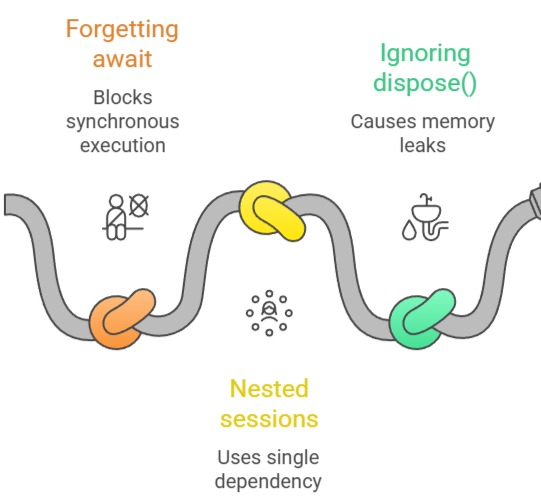
Common Pitfalls