Microservices patterns and API gateways are architectural approaches used to build scalable and maintainable distributed systems.
Microservices patterns focus on breaking applications into small, independent services that communicate over APIs, enabling independent development, deployment, and scaling.
API gateways such as Kong and Traefik act as a single entry point for client requests, handling routing, authentication, rate limiting, and service discovery across multiple backend services.
Microservices Fundamentals
Microservices break down applications into small, focused services, each owning its data and logic.
This pattern contrasts with monoliths and aligns perfectly with full-stack API development, where services expose endpoints for frontend consumption.
Core Principles of Microservices
Adhering to principles like single responsibility and domain-driven design ensures services remain manageable. Let's break it down.
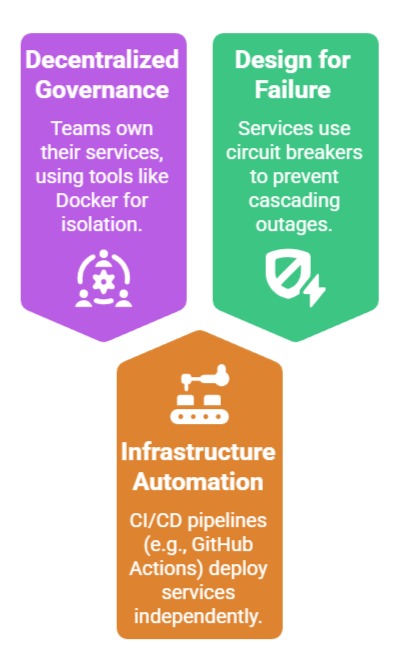
For Example, in an e-commerce app, separate services handle users, orders, and payments—each with its own API.
Common Microservices Communication Patterns
Services interact via synchronous (HTTP/REST, gRPC) or asynchronous (message queues like Kafka) methods. Choose based on needs: sync for real-time queries, async for event-driven workflows.

Practical Tip: Start with REST for APIs in this course, then layer in async with RabbitMQ.
Essential Microservices Patterns
These patterns address pain points like data consistency and service discovery in distributed systems. They form the backbone for scalable full-stack APIs.
API Gateway Pattern
The API gateway acts as a single entry point, routing requests to microservices while handling cross-cutting concerns like auth and rate limiting—no more frontend code cluttered with service URLs.
It simplifies client interactions: your React/Vue frontend calls one gateway endpoint, which fans out internally.
Benefits
1. Protocol translation: Backend gRPC to frontend REST.
2. Request aggregation: Combine responses from multiple services.
3. Security enforcement: Centralized JWT validation.
Example: Netflix's gateway routes video streams, reducing client complexity.
Service Discovery and Circuit Breaker Patterns
Service discovery (e.g., Consul or Kubernetes DNS) dynamically finds services as they scale. Pair it with circuit breakers (via libraries like Resilience4j in Python/FastAPI) to detect failures and fallback gracefully.
Implementation Steps
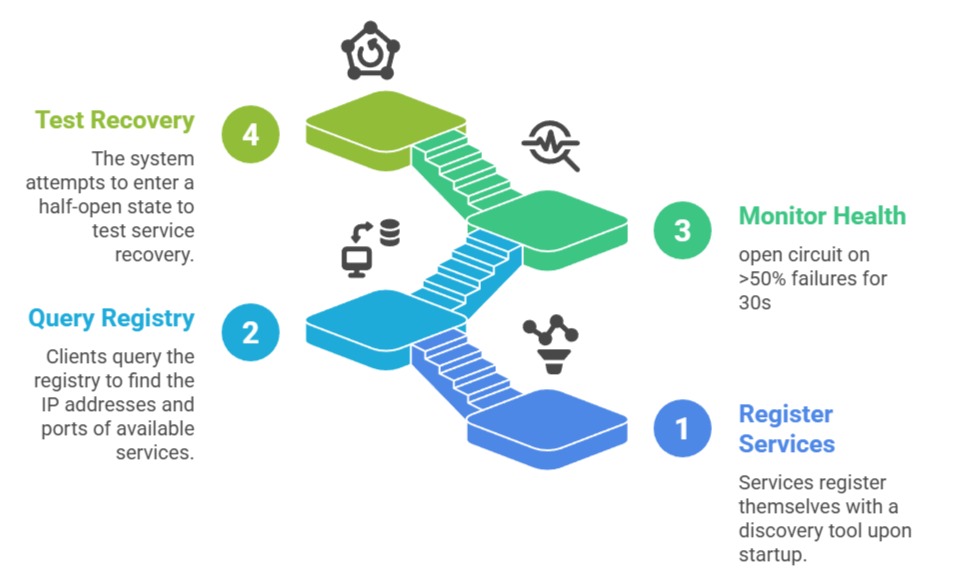
This prevents the "thundering herd" issue in high-traffic full-stack apps.
Database per Service and Saga Patterns
Avoid shared databases with database per service—each owns its schema (e.g., Postgres for users, MongoDB for catalogs). For distributed transactions, use sagas: a sequence of local transactions with compensating actions on failure.
Saga Flow
1. Order service reserves inventory.
2. Payment service charges card.
3. If payment fails, compensate by releasing inventory.
Pro Tip: Tools like Axon Framework automate sagas in Python backends.
API Gateways: Kong and Traefik
API gateways reverse-proxy traffic, adding smarts like load balancing. Kong and Traefik shine in containerized full-stack setups—Kong for enterprise features, Traefik for lightweight auto-discovery.
Kong: Robust and Plugin-Powered
Kong (open-source, declarative config via YAML/DB) excels in high-scale environments with 400+ plugins for auth, logging, and caching. Latest v3.5 (2025) adds AI-driven traffic shaping and WASM plugins for custom logic.
Key Features

Setup in Docker for a FastAPI microservice
docker run -d --name kong \

  -e "KONG_DATABASE=off" \

  -e "KONG_DECLARATIVE_CONFIG=/kong.yml" \

  -e "KONG_PROXY_ACCESS_LOG=/dev/stdout" \

  -p 8000:8000 kong:latest
Use Case: Route /api/users to a Python service, adding mTLS security.
Traefik: Dynamic and Cloud-Native
Traefik auto-configures via labels (e.g., Docker/K8s annotations), ideal for dynamic full-stack deploys. v3.0 (2025) introduces TCP UDP proxying and OpenTelemetry tracing natively.
Standout Capabilities:
1. Auto-service discovery: Watches Docker Compose or Kubernetes.
2. Middleware chain: Strip prefixes, add headers effortlessly.
3. Dashboard: Web UI for real-time insights.
Quick Docker Compose example
services:

  traefik:

    image: traefik:v3.0

    command: --providers.docker=true --entrypoints.web.address=:80

    ports: ["80:80", "8080:8080"]

  whoami:

    image: traefik/whoami

    labels:

      - "traefik.http.routers.whoami.rule=Host(`whoami.localhost`)"
Comparison
 Choose Traefik for quick prototypes in this course; Kong for production.
Hands-On Implementation Best Practices
Integrate these in your full-stack projects step-by-step. Focus on observability with tools like Jaeger for tracing.
Best practices
1. Security first: Enforce HTTPS, API keys, and mutual TLS.
2. Monitoring: Export metrics to Grafana; set alerts on 5xx errors.
3. Versioning: Use /v1/users headers in gateways.
4. Testing: Chaos engineering with Gremlin to simulate failures.
Industry Standards: Follow CNCF's service mesh patterns (e.g., Linkerd) alongside gateways for advanced resilience.