CRUD operations via API endpoints with relationships refer to building backend APIs that allow clients to create, read, update, and delete data across multiple related entities in a database.
These APIs are commonly implemented using RESTful principles and an ORM to manage relationships such as one-to-one, one-to-many, and many-to-many.
By exposing structured endpoints, applications can maintain data integrity while enabling efficient interaction between interconnected resources.
Understanding Relationships
Relationships in databases link tables to model real-world connections, such as one-to-many (one user has many posts) or many-to-many (posts have many tags, tags belong to many posts).
These require special handling in API endpoints to avoid data inconsistencies or N+1 query problems, where fetching related data triggers excessive database calls. Proper design uses ORM features like SQLAlchemy's relationship() for automatic joins.
Key Relationships

Defining Models with Relationships
Start by modeling entities with SQLAlchemy or similar ORMs, using declarative_base() for tables and relationship() for links. For a blog app, define User and Post models where one user owns many posts. Always index foreign keys for performance.
Example models in Python using SQLAlchemy
from sqlalchemy import Column, Integer, String, ForeignKey

from sqlalchemy.orm import relationship

from sqlalchemy.ext.declarative import declarative_base


Base = declarative_base()


class User(Base):

    __tablename__ = "users"

    id = Column(Integer, primary_key=True)

    name = Column(String)

    posts = relationship("Post", back_populates="owner")


class Post(Base):

    __tablename__ = "posts"

    id = Column(Integer, primary_key=True)

    title = Column(String)

    user_id = Column(Integer, ForeignKey("users.id"))

    owner = relationship("User", back_populates="posts")
This setup enables eager loading via joinedload() to fetch related data efficiently.
Basic CRUD Without Relationships
Implement standalone CRUD first to establish patterns: POST for create, GET for read (list/single), PUT/PATCH for update, DELETE for delete. Use Pydantic schemas for validation and FastAPI's dependency injection for database sessions.
Pagination via query params prevents overload.
Standard endpoint patterns follow REST conventions
CRUD with One-to-Many Relationships
For one-to-many, expose related data in reads via nested serialization and handle creation/updates carefully to maintain referential integrity. Use session.add() for new related objects, ensuring foreign keys link correctly.
Best Practice: Cascade deletes via ORM configuration.
Creating Related Resources
To create a post for a user:
1. Fetch the user by ID.
2. Assign post.owner = user.
3. session.add(post); session.commit().
FastAPI example
@app.post("/posts/")

def create_post(post: PostCreate, db: Session = Depends(get_db)):

    user = db.get(User, post.user_id)

    if not user:

        raise HTTPException(404, "User not found")

    db_post = Post(**post.dict(), owner=user)

    db.add(db_post)

    db.commit()

    db.refresh(db_post)

    return db_post
This validates user existence before linking.
Reading with Nested Data
Fetch posts with user details using selectinload()
@app.get("/posts/{post_id}")

def read_post(post_id: int, db: Session = Depends(get_db)):

    post = db.scalars(

        select(Post).options(selectinload(Post.owner)).where(Post.id == post_id)

    ).first()

    if not post:

        raise HTTPException(404, "Post not found")

    return post
Response includes nested owner: {"id":1, "title":"My Post", "owner":{"id":1, "name":"Alice"}}.
Handling Many-to-Many Relationships
Many-to-many uses junction tables; ORMs auto-manage them via secondary arguments in relationship(). Endpoints often separate association management, like /posts/{id}/tags/ for adding tags. Avoid deep nesting to prevent complex payloads.
Example model addition
tags = Table('post_tags', Base.metadata,

    Column('post_id', Integer, ForeignKey('posts.id')),

    Column('tag_id', Integer, ForeignKey('tags.id'))

)


class Post(Base):

    tags = relationship("Tag", secondary=tags, back_populates="posts")
Update endpoint for associations
@app.post("/posts/{post_id}/tags/{tag_id}")

def add_tag(post_id: int, tag_id: int, db: Session = Depends(get_db)):

    post = db.get(Post, post_id)

    tag = db.get(Tag, tag_id)

    post.tags.append(tag)

    db.commit()

    return {"message": "Tag added"}
This treats the relationship as a sub-resource.
Best Practices and Error Handling
Follow RESTful standards: Use HTTP status codes (201 Created, 404 Not Found) and consistent naming. Implement transactions for atomicity in related updates. Secure with authentication to prevent unauthorized deletes.
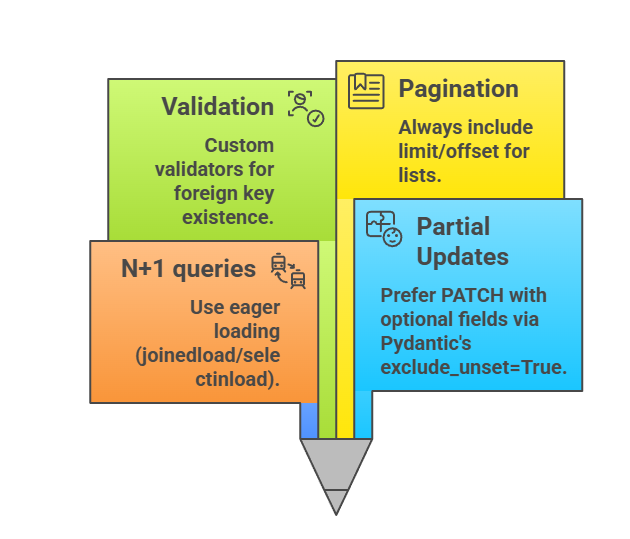
Error Handling Example
if not post:

raise HTTPException(status_code=404, detail="Post not found")[page:1]Test comprehensively with tools like Postman or FastAPI's /docs. Verify cascades (deleting user removes posts) and edge cases (orphaned relations). Use pytest with TestClient for automation.
Sample curl tests
# Create user then post

curl -X POST "http://localhost:8000/users/" -d '{"name":"Alice"}'

curl -X POST "http://localhost:8000/posts/" -d '{"title":"Test","user_id":1}'


# Read with relations

curl "http://localhost:8000/posts/1"
Class Sessions
Sales Campaign

We have a sales campaign on our promoted courses and products. You can purchase 1 products at a discounted price up to 15% discount.