Incident response preparation and forensic readiness form critical pillars of an effective cybersecurity strategy for Linux environments. Preparing for incidents involves establishing policies, resources, and trained personnel to respond quickly and decisively. Forensic readiness ensures that when an incident occurs, meaningful data is captured, preserved, and analyzed to understand the attack, attribute responsibility, and recover securely.
Incident Response Preparation
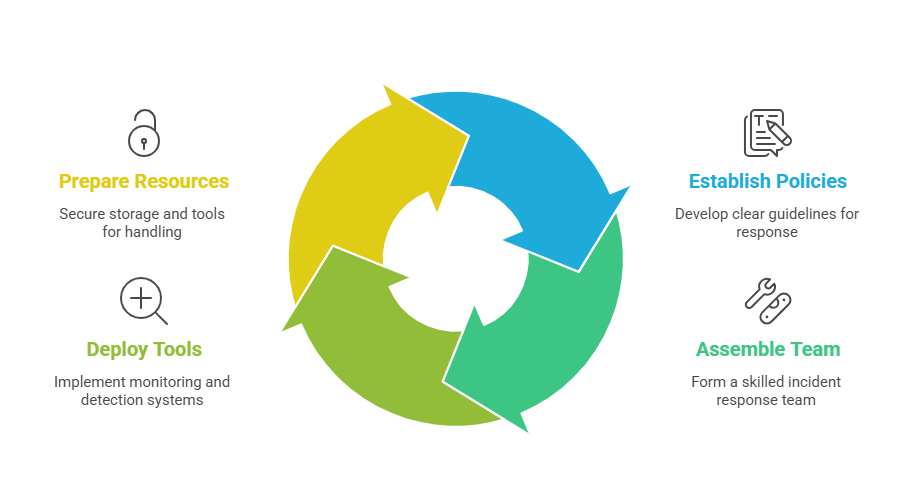 Incident response preparation involves establishing procedures, assembling skilled teams, deploying detection tools, and ensuring resource readiness. The following points explain each essential step for effective incident management.
1. Establish Clear Policies and Procedures
Organizations should develop a well-defined Incident Response Plan (IRP) that clearly outlines roles, responsibilities, communication protocols, and escalation paths during security incidents.
Incident severity levels and classification criteria must be defined to ensure response efforts are prioritized effectively. All policies and procedures should be thoroughly documented and made easily accessible to every member of the incident response team.
2. Assemble and Train an Incident Response Team (IRT)
An effective Incident Response Team should include key stakeholders such as an incident commander, forensic analysts, system administrators, and legal or compliance officers.
Regular training sessions and simulated exercises, including tabletop scenarios and red team drills, help prepare the team for real-world incidents. Strong cross-functional coordination is essential to ensure efficient response, containment, and recovery.
3. Deploy Detection and Monitoring Tools
Early detection of security incidents requires the deployment of monitoring solutions such as IDS/IPS, SIEM platforms, log monitoring, and alerting systems.
Audit logging and file integrity monitoring should be enabled to collect reliable evidence during investigations. Alerts must be carefully configured to reduce noise and alert fatigue while ensuring critical events receive timely attention.
4. Prepare Incident Handling Resources
Organizations should establish secure storage locations for forensic data and evidence to maintain integrity during investigations. Forensic and response tools such as Volatility, OSSEC, and Velociraptor should be pre-deployed to enable rapid analysis and containment.
In addition, well-tested backup and restoration processes are necessary to ensure systems can be recovered quickly and reliably after an attack.
Forensic Readiness Fundamentals
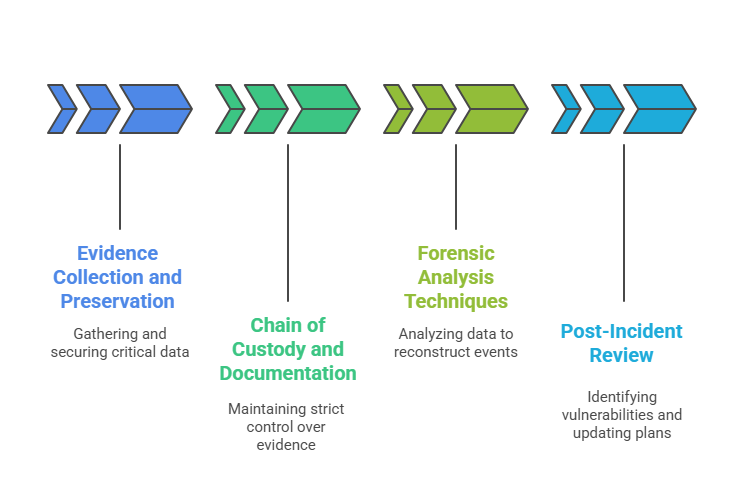
Forensic readiness involves preparing systems and processes to capture actionable evidence during incidents. The following points explain the essential steps for evidence management and post-incident analysis.
1. Evidence Collection and Preservation: Critical data such as logs, memory captures, disk images, and network traffic must be identified and collected carefully. Logs and audit records should be comprehensive and tamper-proof, and tools should enable live data acquisition without significantly altering the system state.
2. Chain of Custody and Documentation: Strict control over evidence is essential, with detailed documentation of every access and transfer. Forensic analysis should be performed on copies rather than original media, and all forensic activities should be logged for audit and legal purposes.
3. Forensic Analysis Techniques: Forensic investigations involve reconstructing timelines to track intruder actions, analyzing memory for stealth malware, and reviewing filesystem and network logs to trace attack vectors and data exfiltration paths.
4. Post-Incident Review: After an incident, root cause analysis identifies vulnerabilities and attack methods. Security controls and incident response plans should be updated accordingly, and comprehensive incident reports should be documented for stakeholders and compliance purposes.

Class Sessions
Sales Campaign

We have a sales campaign on our promoted courses and products. You can purchase 1 products at a discounted price up to 15% discount.