Microservices patterns and API gateways are key architectural concepts for building scalable and maintainable distributed systems.
Microservices patterns define best practices for designing independent services that communicate over APIs, while API gateways act as a single entry point to manage requests, routing, security, and aggregation.
Together, they help simplify complexity and improve system reliability.
What Are Microservices?
Microservices represent a architectural style where applications compose of loosely coupled, independently deployable services, each focused on a specific business capability.
Unlike traditional monoliths, they promote scalability and easier maintenance.
This pattern revolutionizes web development by allowing teams to work in parallel, aligning perfectly with your JavaScript skills for building interactive frontends that consume diverse APIs.
Core Principles of Microservices
Microservices adhere to key principles that ensure they remain manageable and efficient:

For Example, in an e-commerce app, a payment service processes transactions separately from an inventory service, letting you update one without redeploying everything.
Benefits and Challenges
Adopting microservices brings clear advantages but demands careful planning.
Benefits
1. Faster deployments through independent CI/CD pipelines.
2. Technology diversity—use Node.js for one service, Python for another.
3. Fault isolation; if one service crashes, others survive.
Challenges
1. Increased operational complexity (e.g., service discovery).
2. Network latency between services.
3. Data consistency across boundaries.
Common Microservices Patterns
Patterns provide proven blueprints for tackling microservices complexities, drawing from industry standards like those in Chris Richardson's Microservices Patterns.
These reusable solutions help you design resilient systems that pair well with your frontend JavaScript apps for real-time updates.
Decomposition Patterns
Start by breaking down monoliths effectively:
1. Break by business capability (e.g., separate orders from users).
2. Identify bounded contexts from Domain-Driven Design (DDD).
3. Use strangler fig pattern Gradually replace monolith parts with services.
Example: Migrate a blogging app's user management into a microservice, exposing it via REST APIs your HTML/JS frontend queries.
Communication Patterns
Services must communicate reliably—here's how:
1. Synchronous (Request-Response): Use HTTP/REST for simple queries.
2. Asynchronous (Events): Publish events via Kafka or RabbitMQ for loose coupling.
Key Patterns:
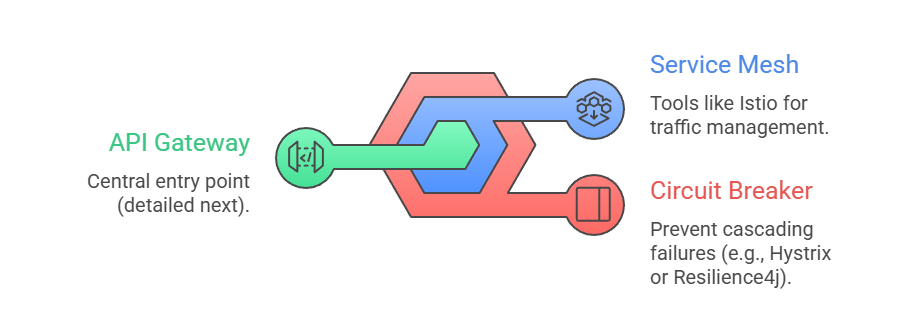
Data Management Patterns
Handle data silos wisely
1. Database per Service: Ensures independence.
2. Saga Pattern: Coordinate distributed transactions via events.
3. CQRS (Command Query Responsibility Segregation): Separate reads/writes for performance.
In practice, for a JavaScript dashboard app, CQRS lets your frontend pull optimized read models from a dedicated query service.
API Gateways: The Front Door
An API Gateway acts as a single entry point for clients, routing requests to backend microservices while handling cross-cutting concerns. It's essential for hiding complexity from your frontend code.
Think of it as a smart proxy: your HTML/JS app hits one URL, and the gateway fans out requests, aggregates responses, and enforces security.
Key Features and Best Practices
API Gateways offer these capabilities per industry leaders like Kong and AWS API Gateway (updated with 2025 features like AI-driven traffic shaping):

Implementation Steps:
1. Deploy gateway (e.g., Express Gateway for Node.js).
2. Define routes: /users → User Service.
3. Add middleware for auth and logging.
4. Test with tools like Postman.
Example Configuration (Kong declarative YAML snippet):
services:

- name: user-service

  url: http://user-service:3000

routes:

- name: users

  paths: ["/users"]

plugins:

- name: rate-limiting

  config:

    minute: 100
Comparison of Popular API Gateways
 Integrating with Frontend Development
Tie microservices back to your course skills: JavaScript fetches from API Gateways via Fetch API or Axios.
Practical Tips
1. Use GraphQL over gateways for flexible queries (e.g., Apollo Gateway).
2. Implement client-side caching with SWR or React Query.
3. Handle errors gracefully Gateways return unified 4xx/5xx codes.
Sample JS Code
fetch('/api/gateway/users/1')

  .then(res => res.json())

  .then(data => updateUI(data))

  .catch(err => showError('Service temporarily unavailable'));
This setup scales your vanilla JS or React apps effortlessly.

Class Sessions
Sales Campaign

We have a sales campaign on our promoted courses and products. You can purchase 1 products at a discounted price up to 15% discount.