Adopting DevOps is not just a technical decision, it is a strategic one. Organizations across the world, from small startups to large enterprises, have embraced DevOps because of the very real and measurable benefits it delivers.
DevOps transforms the way software is built, tested, deployed, and maintained — and in doing so, it transforms the way teams work, communicate, and grow.
The benefits of DevOps go beyond faster releases; they touch every aspect of a technology organization, from team culture and employee satisfaction to business agility and customer experience.
Faster Software Delivery
One of the most immediate and visible benefits of DevOps is the ability to deliver software faster than ever before. In traditional development cycles, releasing a new feature or fix could take weeks or even months.
With DevOps, teams can release multiple times a day — safely and reliably.
This speed is made possible through:
1. Continuous Integration and Continuous Delivery (CI/CD) pipelines that automate building, testing, and deployment.
2. Automated testing that removes the need for lengthy manual QA cycles.
3. Small, frequent releases that are easier to manage and less risky than large, infrequent ones.
Improved Collaboration and Team Culture
Before DevOps, development and operations teams worked separately, often with conflicting goals. DevOps brings these teams together under a shared sense of ownership and responsibility. This cultural shift has profound benefits:
1. Teams communicate more openly and frequently
2. Misunderstandings and delays caused by handoffs between teams are significantly reduced
3. A blameless culture emerges, where failures are treated as learning opportunities rather than occasions for finger-pointing
4. Employee satisfaction improves because people feel empowered, trusted, and part of a larger mission
This improved collaboration does not just make work more pleasant — it directly translates into better software and faster delivery.
Higher Software Quality and Reliability
DevOps does not treat quality as a final checkpoint before release. Instead, quality is built into every stage of the development process through automated testing, code reviews, and continuous monitoring.
Key quality benefits include:
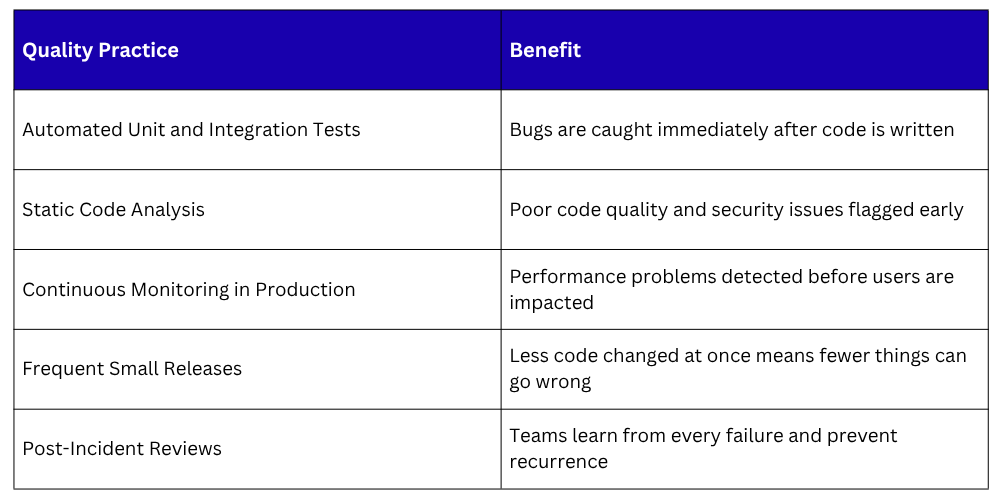
The result is software that is more stable, secure, and dependable — which directly benefits end users and the business alike.
Faster Incident Detection and Recovery
No system is perfect. Incidents, bugs, and outages will happen at some point. What matters is how quickly a team can detect, respond to, and recover from those incidents.
DevOps significantly improves this through:
1. Real-time monitoring and alerting — tools like Prometheus and Grafana notify teams the moment something goes wrong
2. Centralized logging — makes it easy to trace the root cause of an issue quickly
3. Automated rollback capabilities — if a deployment causes a problem, it can be rolled back automatically with minimal disruption
4. Runbooks and documented procedures — ensure that even junior team members can respond to incidents effectively
Organizations practicing DevOps report significantly lower Mean Time to Detect (MTTD) and Mean Time to Recover (MTTR) — two of the most important reliability metrics in operations.
Continuous Improvement and Innovation
DevOps creates an environment where learning and improvement are constant. Through continuous feedback loops, retrospectives, and monitoring insights, teams are always identifying what can be done better — and acting on it.
This culture of improvement leads to:
1. Regular retrospectives that identify process inefficiencies
2. Data-driven decisions based on real monitoring and usage metrics
3. Experimentation encouraged — teams try new ideas without fear of catastrophic failure
4. Engineers who grow continuously in skills, knowledge, and confidence
5. Products that evolve rapidly in response to real user needs
DevOps does not just deliver better software today — it builds the capability to deliver even better software tomorrow.
Reduced Costs and Increased Efficiency
While the initial investment in DevOps tooling and training requires resources, the long-term cost savings are substantial. Here is how DevOps reduces costs over time:
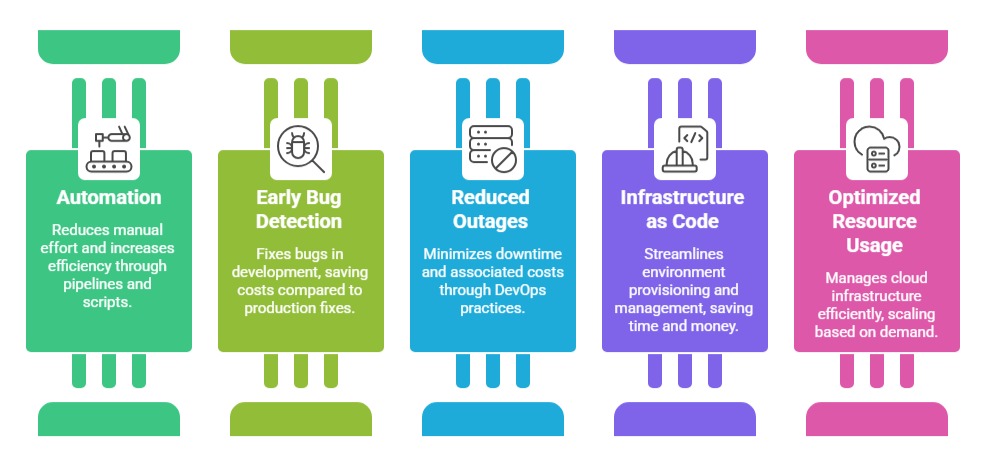
A well-implemented DevOps practice ultimately delivers more output with fewer resources, a compelling argument for any business leader.
Enhanced Security — The Rise of DevSecOps
Traditionally, security was handled at the very end of the development cycle — a final scan before release. This approach was too slow and too late. DevOps introduces the concept of DevSecOps, where security is integrated into every phase of the pipeline.
Benefits of this approach include:
1. Security vulnerabilities are identified and fixed early in development, where they are cheapest and easiest to address.
2. Automated security scanning runs on every code commit, not just at release time.
3. Compliance checks are built into the pipeline, making audits faster and simpler.
4. The entire team — not just a separate security team, is aware of and responsible for security.
In DevOps, security is not a gate at the end of the process — it is a thread woven through the entire fabric of development and delivery.
Better Customer Experience
All of the technical and cultural benefits of DevOps ultimately serve one final purpose, delivering a better experience for the customer.
When teams can release faster, recover quicker, maintain higher quality, and continuously improve, users feel the difference.
1. New features reach users faster, keeping the product competitive and relevant.
2. Bugs and performance issues are fixed quickly, before they frustrate large numbers of users.
3. Products are more stable and reliable, building user trust over time.
4. Teams can respond to user feedback rapidly, making customers feel heard and valued.