In modern software development, speed and reliability are not opposing forces, they are complementary goals.
The practice that makes both possible simultaneously is CI/CD, which stands for Continuous Integration and Continuous Delivery (or Continuous Deployment).
CI/CD is one of the most important and widely adopted practices in DevOps, and for good reason.
It transforms the way software moves from a developer's local machine to the hands of end users, replacing slow, risky, manual processes with fast, automated, and dependable pipelines.
The Problem CI/CD Was Built to Solve
To truly appreciate CI/CD, it helps to understand what software delivery looked like without it. In traditional development environments, teams followed a pattern that was slow, stressful, and unreliable:
1. Developers worked on large features in isolation for weeks or months.
2. Code from multiple developers was combined all at once — a process called "big bang integration".
3. Integration almost always caused conflicts, broken builds, and cascading failures.
4. Testing happened manually at the very end of the development cycle.
5. Deployments were rare, high-risk events, often scheduled for weekends or late nights to minimize impact.
6. When something broke in production, finding the cause was difficult because so much had changed at once.
This approach led to what many teams called "integration hell" — a painful, time-consuming, and demoralizing experience that slowed down delivery and eroded confidence.
CI/CD was developed specifically to eliminate these problems.
What is Continuous Integration (CI)?
Continuous Integration is the practice of developers merging their code changes into a shared repository frequently, ideally multiple times per day and having each merge automatically trigger a series of build and test processes to validate the change.
The core idea is simple but powerful: the longer code sits unintegrated on a developer's machine, the harder it becomes to merge and the more bugs accumulate undetected.
CI solves this by making integration a daily habit rather than an occasional, painful event.
What Happens in a CI Process
Every time a developer pushes code to the shared repository, the CI system automatically:
1. Pulls the latest code from the repository
2. Compiles or builds the application
3. Runs automated tests — unit tests, integration tests, and code quality checks
4. Reports the result, pass or fail back to the developer almost immediately
5. Blocks merging if any test fails, preventing broken code from reaching the main branch
This tight feedback loop means that bugs are caught within minutes of being introduced, not weeks later — making them far cheaper and easier to fix.
Key Principles of CI
1. Every developer commits code to the shared repository at least once per day
2. The main branch should always be in a buildable, working state
3. Broken builds are treated as a top priority, the team stops and fixes them immediately
4. Automated tests are the safety net, they must be comprehensive and fast
5. The CI pipeline must run quickly (ideally under 10 minutes) so feedback is immediate
What is Continuous Delivery (CD)?
Continuous Delivery extends Continuous Integration by ensuring that after code passes all automated tests, it is automatically prepared and packaged so that it is always in a deployable state.
The key word here is ready — the software can be released to production at any time, but the actual release decision is made by a human.
This might sound subtle, but it is a significant shift in mindset. In traditional development, a deployment was a rare, complicated event requiring extensive preparation. With Continuous Delivery:
1. Every successful build produces a release candidate, a version that is ready to go live.
2. Deployments to staging or pre-production environments happen automatically.
3. Releasing to production is as simple as clicking a button or making a business decision.
4. The risk of each release is dramatically lower because changes are small and incremental.
The Role of the Deployment Pipeline
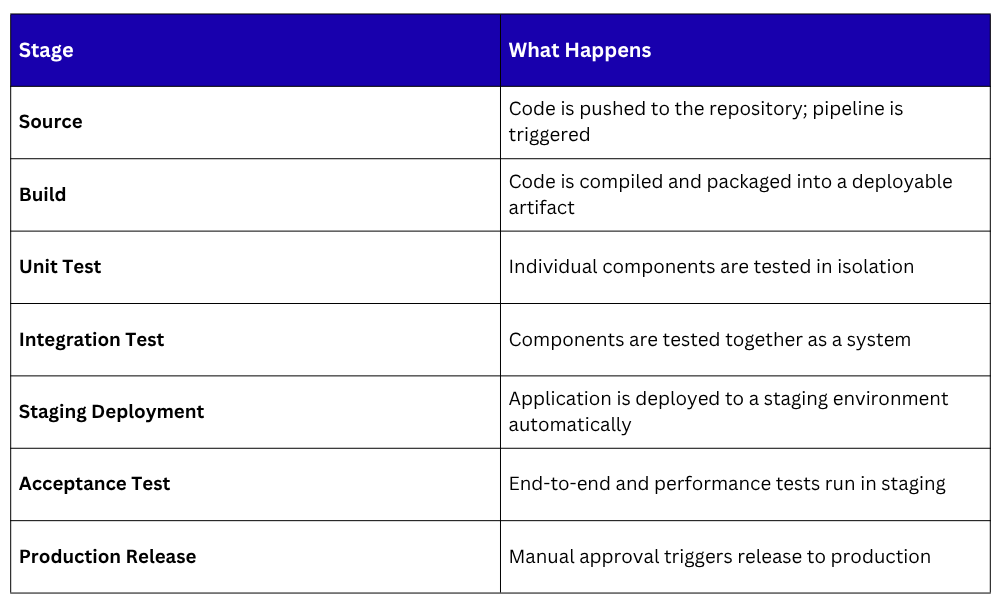
In Continuous Delivery, the deployment pipeline is the automated path that code travels from the developer's commit to a production-ready artifact. A typical pipeline includes:
What is Continuous Deployment?
Continuous Deployment is often confused with Continuous Delivery, but there is one critical distinction:
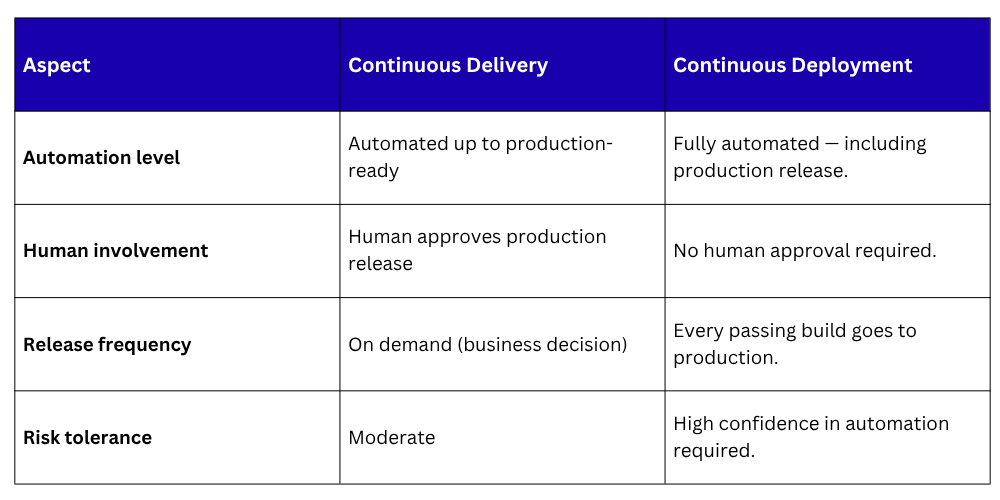
In Continuous Deployment, every code change that passes all automated tests is automatically deployed to production — without any human intervention. This requires an extremely high level of confidence in the automated test suite and monitoring systems.
Not every organization practices Continuous Deployment, it depends on the risk tolerance, regulatory environment, and maturity of the team. However, Continuous Delivery is considered a best practice for virtually all modern software teams.
The CI/CD Pipeline
The CI/CD pipeline is the automated sequence of steps that every code change passes through from the moment a developer pushes code to the moment it reaches users. It is the practical implementation of CI/CD concepts.
A well-designed pipeline acts as an automated quality gate, only allowing code that meets all defined standards to progress toward production.
Stages of a Typical CI/CD Pipeline
Each stage serves a specific purpose:
1. Source Stage: The pipeline is triggered automatically when code is pushed to the repository or a pull request is opened. No manual action is required to start the pipeline.
2. Build Stage: The application is compiled, dependencies are resolved, and the code is packaged into a deployable artifact — such as a JAR file, Docker image, or binary.
3. Test Stage: Multiple layers of automated tests run in sequence:
Unit tests: Test individual functions and methods
Integration tests: Test how components interact with each other
End-to-end tests: Simulate real user scenarios through the entire application
4. Code Quality and Security Scan
Static code analysis tools check for code smells, complexity, and maintainability issues
Security scanners identify known vulnerabilities in code and dependencies
5. Staging Deployment: The application is automatically deployed to a staging environment that closely mirrors production. This is where final validation happens before any production release.
6. Production Deployment: Depending on whether the team practices Continuous Delivery or Continuous Deployment, this stage either requires a manual approval or happens automatically.
Why CI/CD is Important
CI/CD is not just a technical improvement, it delivers measurable benefits across the entire organization.
For Development Teams
1. Faster feedback: Developers know within minutes whether their code works, rather than finding out weeks later
2. Reduced integration risk: Small, frequent merges are far less risky than large, infrequent ones
3. Higher confidence: Automated tests give developers the confidence to make changes without fear of breaking things
4. Less manual work: Automation handles repetitive tasks, freeing engineers for meaningful work
5. Cleaner codebase: Continuous quality checks enforce coding standards consistently
For Operations Teams
1. Stable deployments: Automated, consistent deployments reduce human error
2. Faster recovery: Smaller releases mean problems are easier to identify and roll back
3. Better visibility: dashboards give real-time insight into the health of every build and deployment
4. Audit trail: Every deployment is logged, providing full traceability for compliance and troubleshooting
For the Business
1. Faster time to market: Features reach customers faster, providing a competitive advantage.
2. Lower cost of failure: Catching bugs early in the pipeline is dramatically cheaper than fixing them in production.
3. Increased customer satisfaction: More frequent, higher-quality releases translate directly to a better user experience.
4. Reduced deployment risk: Frequent small releases are far less disruptive than occasional large ones.
CI/CD and DevOps — How They Connect
CI/CD is not a separate concept from DevOps — it is one of its most concrete and practical expressions. The three core DevOps principles map directly onto CI/CD:

CI/CD pipelines are also the connective tissue between other DevOps practices:
1. Version control triggers the pipeline.
2. Infrastructure as Code provisions the environments the pipeline deploys to.
3. Containerization packages applications consistently across pipeline stages.
4. Monitoring validates deployments after they reach production.
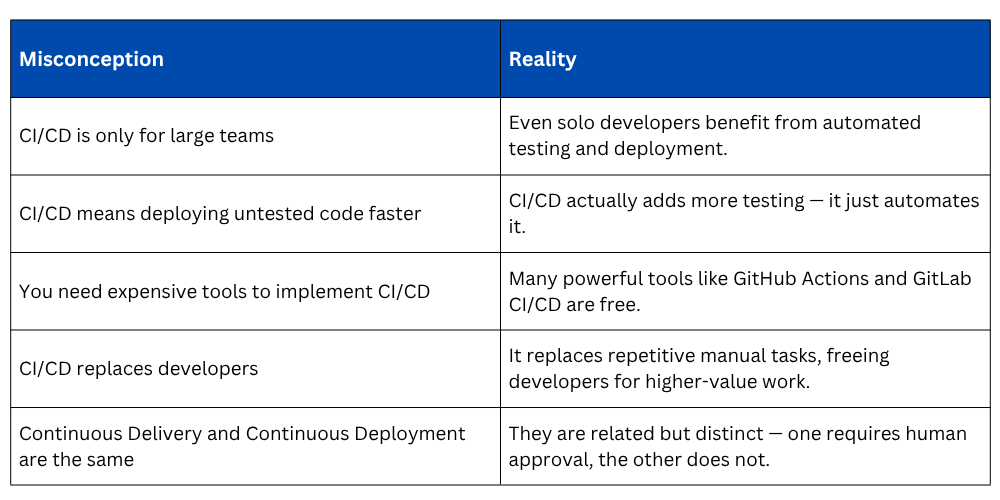
Common Misconceptions About CI/CD