Lambda functions are designed to do one thing well. But real-world processes rarely involve just one step, they involve a sequence of steps, decisions, parallel tasks, error handling, and retries.
Chaining Lambda functions together with custom code to handle all of this becomes complicated and fragile very quickly.
AWS Step Functions solves this by giving you a managed, visual way to orchestrate multi-step workflows reliably — without writing the coordination logic yourself.
What is AWS Step Functions?
Step Functions is a serverless workflow orchestration service. You define a workflow as a series of steps, called a state machine — and Step Functions executes those steps in order, handles errors, manages retries, and tracks the state of every execution.
Each step can invoke a Lambda function, call an AWS service, wait for human approval, or run tasks in parallel.
The key benefit is that the coordination logic — sequencing, branching, error handling, retries — lives in Step Functions, not scattered across your Lambda code.
Core Concepts
1. State Machine
A state machine is the definition of your workflow. It describes every step, the transitions between steps, and the error handling behaviour. It is defined in a language called Amazon States Language (ASL) — written in JSON or YAML.
2. States
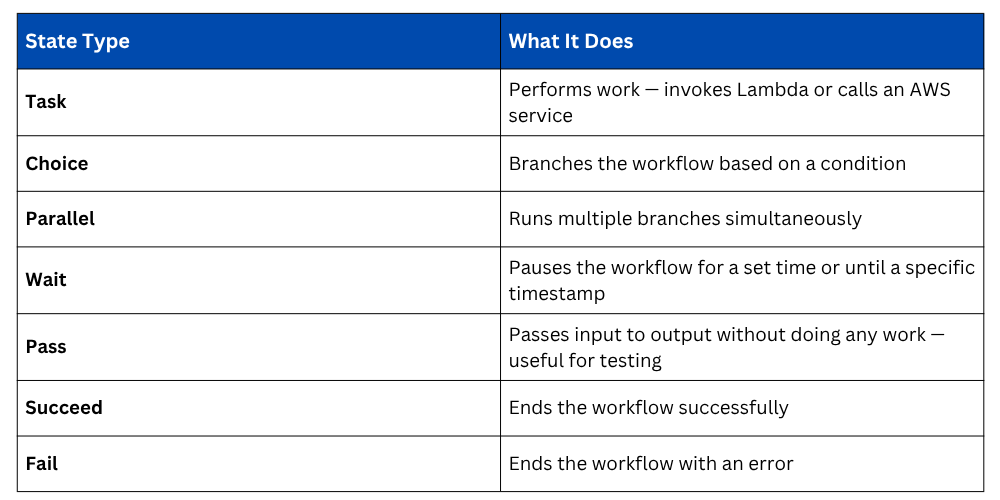
Each step in a workflow is a state. Step Functions supports several state types:
3. Execution
An execution is a single run of a state machine. Every execution has its own input, its own state history, and its own output. You can run thousands of executions of the same state machine simultaneously — each one is fully independent.
Error Handling and Retries
This is where Step Functions provides enormous value over hand-rolled Lambda chains. You define retry and error handling behaviour directly in the state machine, not in your application code.
1. Retries: If a Lambda function fails due to a temporary error — a timeout, a throttle, a transient network issue — Step Functions can automatically retry it a specified number of times with a configurable backoff interval. No custom retry logic needed in your code.
2. Catch: If a step fails after all retries are exhausted, you can define a fallback path — route to a different state, send an alert, clean up resources, or end the execution gracefully with an error message.
This makes workflows resilient without making the individual Lambda functions complicated.
Workflow Types
Step Functions offers two workflow types:
Standard Workflows
1. Can run for up to one year.
2. Every state transition is logged and auditable.
3. Charged per state transition.
4. Best for long-running processes, business workflows, and anything requiring a full audit trail.
Express Workflows
1. Run for up to five minutes.
2. Higher throughput — designed for high-volume, short-duration workloads.
3. Cheaper per execution.
4. Best for real-time data processing, IoT pipelines, and high-frequency event handling.
Real-World Use Cases
1. Order processing pipeline: Validate order → charge payment → update inventory → send confirmation email → notify warehouse. Each step is a Lambda function. Step Functions sequences them, retries on failure, and handles errors at each stage.
2. CI/CD pipeline orchestration: Run tests → build Docker image → push to ECR → deploy to staging → run smoke tests → await approval → deploy to production. Step Functions manages the entire flow including the human approval step.
3. Data processing workflow: Receive file upload event → validate file format → transform data → load into database → notify downstream systems. Parallel branches handle independent steps simultaneously.
4. Machine learning pipeline: Prepare training data → train model → evaluate model quality → if quality passes, deploy model → if not, alert team and stop. The Choice state handles the conditional branching.
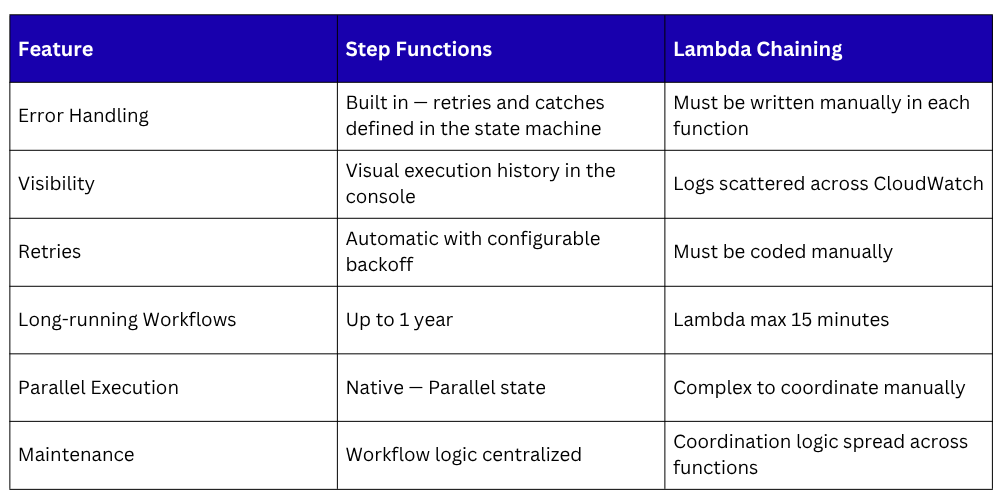
Step Functions vs. Lambda Chaining

Class Sessions
Sales Campaign

We have a sales campaign on our promoted courses and products. You can purchase 1 products at a discounted price up to 15% discount.